
Procurement Guide: Hiring Event Management Companies in Dubai
By Humais Waqar, Marketing Head · 11 Nov 2026 · 8 min read

Planning a corporate event? Purrple Orryx is a corporate event management company in Dubai: we plan and deliver corporate events end to end.
Procurement should run an event agency tender like any services tender, with one important change: separate the creative concept from the production delivery, because they are priced, owned and compared differently. A fair process in Dubai needs a written brief, a quote template that forces like-for-like pricing, a scoring sheet agreed before bids arrive, and a document check on each agency's licence and tax registration.
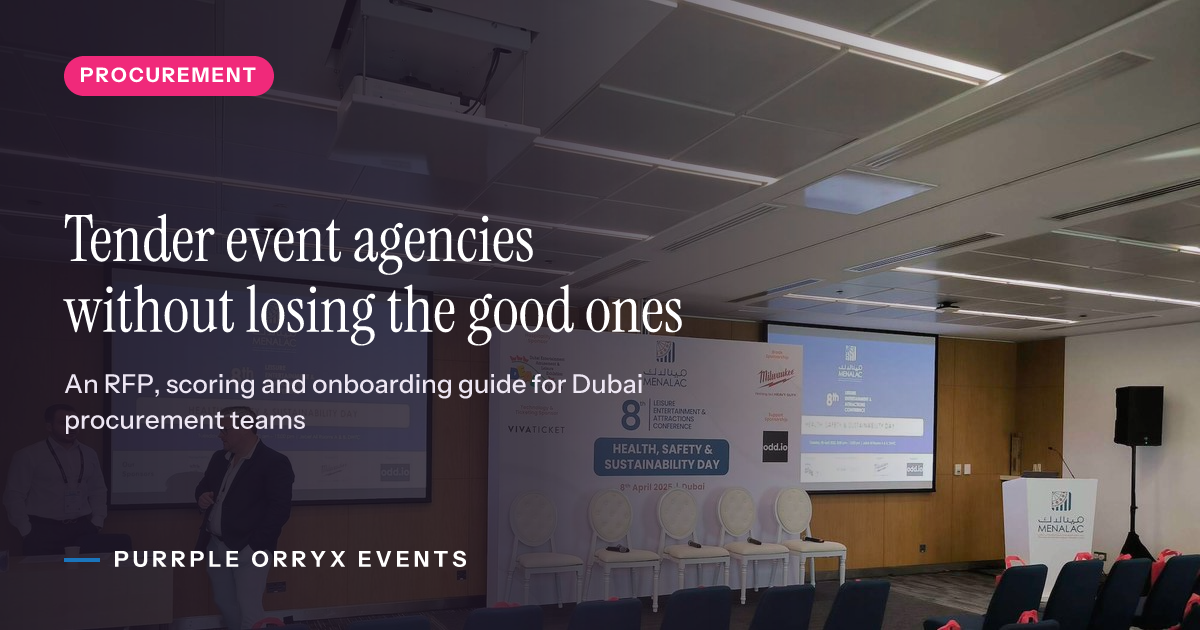
We are an event production agency in Dubai, so we sit on the receiving end of tenders. This guide is written to help you get comparable bids and a good result, and it is as useful to you as it is to the agencies you invite.
How do we shortlist event management companies in Dubai fairly?
Shortlist on evidence, not on who answers the phone first. Aim for three to five agencies. Fewer than three gives you no real comparison, and more than five costs you review time and costs every agency a proposal they have little chance of winning.
Set the filters before you search, so the shortlist is defensible if someone asks later:
- Relevant format: the agency has produced your type of event (conference, gala dinner, family day, launch, exhibition) at a similar guest count band, for example 100 to 300 or 300 to 1,000.
- Delivery capacity: the agency states what it runs with its own team and what it subcontracts, such as sound, lighting, LED, staging and fabrication.
- Documented proof: case studies you can read in full, with the scope and venue stated, rather than a logo wall.
- Compliance: a valid trade licence and tax registration that you can verify, covered below.
- Geography: if the event spans emirates or Saudi Arabia, ask how the agency staffs and permits outside Dubai.
Ask each agency the same three screening questions in writing, and keep the answers on file. That alone makes the shortlist auditable.
How should an event RFP be structured so quotes compare like for like?
Most unfair comparisons come from a loose brief. If one agency prices a 300-seat ballroom with a basic stage and another prices a stage with a full LED wall, the totals mean nothing. Fix the scope in the RFP and make agencies price against it.
A workable RFP has these sections:
- Objective and audience: why the event exists, who attends, and what a good outcome looks like for your business.
- Fixed parameters: date or date window, guest count band, city, venue if already chosen, and any brand or security rules.
- Scope of work: programme length, content segments, technical production (sound, lighting, LED, staging), catering approach, guest transport, registration and any gifting.
- Quote template: one sheet, identical for every bidder, with line items grouped as creative and planning fees, production and technical, venue and catering pass-throughs, staffing, permits, and agency management fee.
- Assumptions and exclusions: each agency lists what it has assumed and what is not included, so hidden gaps appear before award.
- Commercial terms: payment schedule, cancellation, change control, insurance and liability expectations.
- Timeline and contacts: question deadline, submission date, presentation date and decision date.
Hold one written Q and A round and share every answer with all bidders. If an agency asks a question that changes the scope, everyone should hear it. Our own working method is set out on how we work, and a brief that covers the points above lets us price accurately the first time.
How do we score agencies and spot an unrealistically low quote?
Agree the scoring sheet before bids arrive and do not change it afterwards. Weight price so it matters but cannot decide the result alone. A typical split gives price a third of the score or less, with the remainder on approach, team and proof.
A scoring sheet you can adapt
Signs a quote is too low to be real
A low total is not a problem in itself. A low total that you cannot explain is. Check for these:
- Line items for technical production sit far below the other bids for the same spec. Ask for the equipment list and crew numbers behind them.
- No contingency, no insurance line and no permit line, where the other agencies show all three.
- Staffing is vague. Ask who is on site on event day, and who is the single point of contact.
- Assumptions are missing, which usually means change requests will follow.
Ask the agency to walk you through the quote line by line. A genuine bid survives that conversation, and a thin one tends to expose itself.
| Criterion | Suggested weight | What to look for |
|---|---|---|
| Understanding of the brief | 20% | Restates your objective and audience accurately, and flags risks |
| Approach and creative thinking | 20% | Specific programme ideas that fit the guest count and venue |
| Delivery team and capacity | 20% | Named lead, on-site crew, in-house versus subcontracted work |
| Relevant proof | 15% | Case studies of similar format and scale, with references |
| Price and clarity of quote | 25% | Complete line items, stated assumptions, no unexplained gaps |
What documents should an agency supply to be onboarded as a vendor?
Requirements differ between organisations, but UAE vendor forms follow a familiar pattern. Public supplier forms we reviewed, including those from utilities and government media bodies, ask for the issuing authority, trade licence number and expiry date, licence type and city, and VAT registration details. Build your checklist from the same fields:
- Valid trade licence, with the activity listed matching event management or production, and the licence expiry date.
- VAT registration certificate and tax registration number (TRN), where the agency is registered.
- Bank account certificate or bank letter in the agency's legal name, so payment details match the invoice.
- Chamber of Commerce registration, if your own policy requires it.
- Ownership and authorised signatory details, with a copy of the signatory's ID.
- Public liability and, where relevant, workers' insurance certificates.
- Company profile and references you can contact.
Check that the trade name on the licence matches the name on the quote and the invoice. A mismatch causes payment and tax problems later. If you work with Saudi Arabia, ask for the equivalent Saudi registration documents for any work delivered there, and confirm requirements with your own legal or finance team.
Is it acceptable to share one agency's concept with other bidders?
No, not as a normal practice. A concept is the agency's work product. Passing one agency's creative idea or visuals to other bidders so they can price it more cheaply is unfair, and it discourages good agencies from putting real thinking into proposals. It also exposes you to ownership disputes.
A cleaner way to handle this:
- Split the tender. Ask for a paid concept stage from a short list, then tender production against the chosen concept, or award both stages to the same agency.
- State ownership in the RFP. Say who owns the concept, designs and drawings if the agency is not appointed, and whether a concept fee buys a licence to use them.
- Ask for ideas, not finished designs, at the first round. A short approach document and a presentation are enough to score creative thinking.
- Keep every agency's submission confidential, and record that you have done so.
If you want to compare production prices, issue a neutral specification that you wrote yourself, with no agency's branding or design in it.
Who is responsible for event permits and licences, the agency or the client?
Settle this in the contract, because the answer depends on the event, the venue and the authority involved. In general practice, the agency applies for and manages permits as part of its scope, while the client supplies the information and signatures only it can provide. Hotels and large venues often handle part of the process for events held inside them, while public spaces, outdoor sites and activations in malls bring extra approvals.
Do not assume. Ask each bidder to state in its response:
- which permits and approvals the event is likely to need;
- which of these the agency will apply for, and which the venue or client must;
- the lead time it assumes for approvals, and who carries the risk if a permit is delayed.
Confirm current rules with the venue and the relevant authority for your emirate, since requirements change and differ between Dubai, Abu Dhabi and Saudi Arabia. Agencies with in-house production, such as our event production team in Dubai, usually manage technical and safety documentation alongside the permit application, which keeps one party accountable.
How much lead time does a fair tender need in Dubai?
Plan the tender as a project of its own. As a working guide, allow one week to prepare the brief, one to two weeks for bids, one week for presentations and scoring, and one to two weeks for contract and onboarding. That is four to six weeks before the agency can start detailed planning.
Then add the event lead time. A conference or gala dinner for 200 to 500 guests typically needs eight to twelve weeks of production planning after award, and longer if there is fabrication, a multi-city programme or a large family day. Dubai's busiest period runs from October to April, with venues filling quickly around year-end, so start earlier for those dates. Ramadan and Eid shift dates each year, so check the calendar before you fix a window.
For complex briefs you can also speak to an agency before issuing the RFP, as a market check. Our expert event management page explains what a full-service scope normally covers, which helps you write a sharper specification.
FAQs
Can VAT on exhibition and conference services be refunded to non-resident businesses?
The UAE Federal Tax Authority runs a VAT refund scheme for exhibitions and conferences. Its user guide says the supplier's application needs a valid trade licence whose trade name matches the supplier name, valid for at least one month from the application date, plus the event permit where one applies. Eligibility depends on your circumstances, so confirm with a tax adviser and the FTA guide at tax.gov.ae.
Does the agency need a mainland, free zone or other licence to work for us?
Ask the agency to state its licence type, issuing authority and licensed activities, and check that the activity covers event management or production. Whether a particular licence type is enough for a particular event can depend on the venue and the approving authority, so confirm that with the venue and the authority rather than assuming.
Should we ask agencies to pitch for free?
For a large or complex event, a paid concept stage is fairer and produces better ideas. If you ask for unpaid work, keep it to an outline approach and a short presentation, and state in the RFP who owns the material.
How many agencies should we invite to tender?
Three to five is a sensible range. It gives a real comparison without wasting review time or asking agencies to invest in proposals with low odds of winning.
If you are preparing an event tender and want a clear view of scope, timing and production, talk to the Purrple Orryx team about your event.
About the author: Humais Waqar, Marketing Head. Humais Waqar leads marketing at Purrple Orryx Events, the Dubai corporate event management company, and writes about planning conferences, gala dinners, launches and team events in the UAE.